


When was Long Bien Bridge built and what is its history?
Long Bien Bridge was constructed from 1899 to 1902 by French architects Daydé & Pillé, originally named Paul Doumer Bridge, and opened in 1903. It suffered severe damage from 14 bombing raids during the Vietnam War, representing an enduring symbol of local endurance and architectural engineering.
.jpg)
French colonial architecture and the cantilever design
The contract to build the bridge was highly competitive, with the Parisian firm Daydé & Pillé winning the bid over renowned builders like Gustave Eiffel. The architects utilized over 5,000 tons of structural steel to construct the massive frame. They recruited roughly 3,000 local laborers to assemble the intricate metalwork entirely by hand. The resulting cantilever steel structure made it one of the four longest bridges in the world upon its completion.
The bridge served as a critical logistical transport link throughout the 20th century. During the Dien Bien Phu era, it facilitated the movement of troops and supplies. Later, during the Vietnam War, the United States identified the bridge as a strategic target, heavily bombing the central spans. The missing original spans you observe today directly result from these wartime strikes, replaced functionally but never fully restored to their original aesthetic.
.jpg)
Ongoing bridge restoration projects aim to preserve the original iron framework and the rusty rails rather than modernizing them. Government engineers periodically replace heavily corroded rivets and reinforce the weakened stone pillars. Consequently, the structure retains an unpolished authenticity, offering you a direct window into its turbulent past.
How long is Long Bien Bridge?
The bridge spans exactly 2,290 meters across the Red River, directly connecting the central Hoan Kiem and eastern Long Bien districts in Hanoi. The main structure suspended over the river measures nearly 1,682 meters, originally featuring 19 massive cantilevered spans supported by 20 stone pillars.
Approaching the bridge from the city requires navigating an additional 896 meters of elevated access ramps constructed over the urban streets. When walking the entire length, you cover roughly 3.2 kilometers from the first stone step to the opposite bank. The visual impact of this length changes drastically with the seasons, as the river swells during the monsoon, making the towering stone pillars appear much shorter.
(1).jpg)
If you plan to cross the entire structure on foot, expect the journey to take about 40 minutes in one direction without stopping. Most travelers opt to walk only to the midpoint, which hovers above Banana Island, an agricultural sandbar in the middle of the river. This mid-river vantage point provides excellent scale and perspective of the bridge's massive iron lattice.
Can you walk on Long Bien Bridge?
Yes, pedestrians can walk specific parts of the bridge at all times, independent of passing trains. The bridge features dedicated pedestrian walkways on its outer flanks, though these narrow paths require careful navigation around parked motorbikes, street vendors, and uneven concrete slabs.
The on-the-ground reality: A safe walking guide
|
Crossing Mode |
Dedicated Lane Width |
Surface Condition |
Traffic Exposure |
Safety Rating |
|---|---|---|---|---|
|
Walking |
0.8 meters (outer edge) |
Uneven concrete panels, frequent gaps |
Low (separated by curb) |
Moderate (requires caution regarding footing) |
|
Bicycle |
Shared with motorbikes |
Paved asphalt, occasional potholes |
High |
Low (not recommended for novices) |
|
Motorbike |
Approx. 2.5 meters (inner lane) |
Paved asphalt, heavily worn |
Very High |
Moderate (requires local driving experience) |
To access the pedestrian-only walkway, look for the designated concrete stairs on Tran Nhat Duat street on the Old Quarter side. These stairs bypass the chaotic vehicular entry ramps. Furthermore, pedestrians must strictly use the left side of the bridge if heading out of the city, as traffic flows on the left due to the original French design parameters.
Always walk on the right-hand side of your specific pedestrian lane to allow locals to pass. Sturdy, closed-toe shoes are highly recommended. The walkway consists of heavy concrete panels that frequently rattle when traffic passes, and you will encounter significant gaps where the river is visible directly beneath your feet.
.jpg)
The motorbike lane is only separated from the walking path by a low iron curb measuring roughly 20 centimeters. You must stay aware of your surroundings and avoid sudden movements toward the traffic side. When taking photos, stick to the wider designated lookout areas extending slightly over the river, as these prevent you from blocking foot traffic.
📌 Expert Insight:
Active trains still use the tracks daily. Exercise extreme caution when taking photos near the railway and move away immediately upon hearing a train horn. Do not attempt to cross the central train tracks under any circumstances.
Best time to visit and how to get there
The optimal time to visit Long Bien Bridge is during the early morning at sunrise or late afternoon at sunset. Reaching the site requires navigating local traffic from the Old Quarter via a short walk, public bus, or a hired taxi to the main pedestrian stairs.
Optimal timing is non-negotiable
📌 Expert Insight:
To avoid chaotic commuter traffic, you must avoid the rush hours of 7:00-9:00 AM and 5:00-7:00 PM. Target the golden hour windows: Sunrise (5:30-6:00 AM) or Sunset (5:30-6:30 PM).
Visiting during the midday sun presents significant discomfort, as the massive steel structure radiates heat and offers absolutely zero shade. Furthermore, the golden hour lighting specifically enhances the rusted tones of the ironwork, producing vastly superior conditions for architectural photography.
Logistics: From Hoan Kiem Lake to the bridge
If you prefer walking, the bridge sits approximately 30 minutes from Hoan Kiem Lake. Navigate north straight up Hang Ngang street, transitioning into Hang Duong, until you reach the major intersection at Tran Nhat Duat. Use the elevated pedestrian overpass to cross this multi-lane highway safely.
For public transit, take bus No. 03, 11, or 22 from the central districts. These routes provide direct drops at the Long Bien Bus Interchange, located merely 50 meters from the pedestrian entry points. A standard bus ticket costs roughly 7,000 VND and must be paid in exact cash to the onboard conductor.
Alternatively, using a ride-hailing app like Grab provides the most direct access. Fares average 30,000 - 50,000 VND (approx. $1.20 - $2.00 USD) from anywhere within the Old Quarter. Instruct your driver to drop you off at "Ga Long Bien" (Long Bien Railway Station) to guarantee you arrive at the correct pedestrian staircase.
What are the best things to do around Long Bien Bridge?
The best activities around Long Bien Bridge include photographing the structure from high-vantage cafes, exploring the midnight wholesale market beneath the arches, and visiting the riverside flower gardens. You can also sample authentic seasonal street snacks prepared by independent vendors directly on the pedestrian walkways.
Discovering vantage point cafes
For a safer, less chaotic photo opportunity, visit Serein Café & Lounge located directly on Tran Nhat Duat street. This multi-level establishment features a rooftop terrace offering spectacular panoramic views of the bridge's entry arches. Drinks average 80,000 VND, compensating for the premium vantage point.
Alternatively, Hoa Xa Cafe sits integrated into the Long Bien Railway Station itself. This location provides a ground-level, straight-down-the-barrel view of the train tracks and the cantilever structure. It functions as an ideal spot to set up a tripod safely without impeding foot traffic.
(1).jpg)
Exploring Long Bien wholesale market
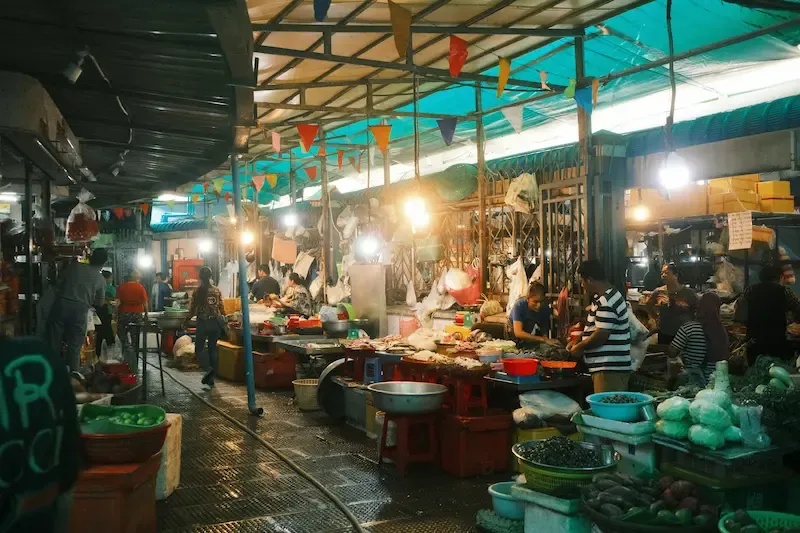
Located directly under the bridge's western approach ramps, this is one of Hanoi's largest agricultural wholesale markets. Peak commercial activity happens between midnight and early morning, specifically from 2:00 AM to 6:00 AM. It offers a raw, non-touristy experience dominated by regional traders and heavy transport carts.
When visiting the market, wear waterproof, easily cleanable footwear. The ground remains persistently wet and slushy due to melting ice used to pack produce and discarded vegetable matter. Keep your camera securely strapped and yield the right of way to laborers pushing heavily loaded dollies.
The Red River Flower Garden
Directly beneath the bridge on the Long Bien district side lies a peaceful nature retreat utilized primarily by local photographers. The entrance fee is around 30,000 - 50,000 VND ($1.20 - $2.00 USD) per person, paid at a small booth near the dirt access road. Accessing this area provides an excellent opportunity to shoot the towering steel pillars from the base level.
The garden fields rotate based on the agricultural season. However, they peak dramatically during the weeks preceding the Lunar New Year (Tet), when rows of peach blossoms and vibrant yellow daisies bloom fully against the backdrop of the rusted steel.
.jpg)
Tasting seasonal street food
📌 Expert Insight:
Vendors set up directly on the bridge. The street snacks, like grilled corn, boiled peanuts, and sweet potatoes, are most authentic and best enjoyed during Hanoi's cooler autumn and winter months.
These vendors operate highly informal stalls, usually consisting of a small charcoal brazier and a few plastic stools placed dangerously close to the traffic lane. When purchasing items, ensure you step entirely onto the pedestrian walkway to avoid passing motorbikes. Prices remain extremely low, typically ranging from 10,000 to 20,000 VND per item.
.jpg)
Why is Long Bien Bridge famous compared to other Hanoi sites?
Long Bien Bridge is famous due to its raw industrial architecture and direct connection to Hanoi's wartime survival. Unlike manicured tourist sites, it functions simultaneously as an active transit route, an untouched historical monument, and a highly authentic local gathering space.
| Criteria | Long Bien Bridge | Hoan Kiem Lake | Newer Bridges (Program 2000) |
|---|---|---|---|
| Vibe | Industrial, unpolished, gritty | Manicured, peaceful, cultural | Modern, sleek, functional |
| Primary Activity | Photography, heritage walking | Leisure walking, temple visits | High-speed vehicular transit |
| Historical Significance | Survived heavy wartime bombing | Legend of the returned sword | Marks 21st-century urban expansion |
| Photo Opportunities | Rusty rails, cantilever spans | Turtle Tower, red wooden bridge | Nighttime LED illumination |
You visit Long Bien Bridge to understand the resilient grit of the city. While Hoan Kiem Lake offers a polished view of local heritage, the bridge forces you to engage with a functional, loud, and uncompromising piece of local infrastructure. This active reality is exactly what makes the crossing a mandatory experience for serious travelers.
.jpg)
---Related Articles---
- The complete guide to Vietnam visa on arrival
- Vietnam visa exemption: Latest rules, 5-year certificates, and entry conditions
- Hoa Lo Prison: History, tickets, and insider tips 2026
- Vietnam visa extension and visa runs: Latest rules and DIY steps





Comments