

What is Hoa Lo Prison famous for?
Hoa Lo Prison is a famous French colonial relic that was once used to imprison Vietnamese revolutionaries and later as a North Vietnamese prison for American prisoners of war, including Senator John McCain, famously known as the "Hanoi Hilton." Today, the remaining complex serves as an important historical landmark.
French colonial period
The French authorities built this structure to be almost impenetrable. The builders used imported steel doors, reinforced padlocks, and surrounded the perimeter with 4-meter-high stone walls topped with high-voltage power lines and broken glass. The colonial government designed this complex specifically to imprison political prisoners and independence fighters who opposed French rule.
Conditions during this period were notoriously harsh. Prisoners faced severe overcrowding, with cells housing four times their intended capacity. Prisoners were frequently shackled to long, steep wooden platforms. Poor sanitation and widespread disease claimed many lives even before scheduled executions.
.jpg)
American prisoner of war period
From 1964 to 1973, North Vietnam renovated several areas of the prison to hold American pilots shot down during bombing campaigns. The prisoners of war sarcastically nicknamed the facility "Hanoi Hotel" to mock the harsh living conditions. Artifacts from this period bear a distinctly different character compared to the colonial-era sections.
The exhibits in this area include items from captured pilots. You'll see Senator John McCain's flight suit and parachute, found after his plane was shot down over nearby Truc Bach Lake. The exhibits mainly consist of images of prisoners of war celebrating holidays, receiving medical care, and playing sports on the grounds.
.jpg)
Where is Hoa Lo Prison located and how do I get there?
The prison is located at 1 Hoa Lo Street, Hoan Kiem District, in the heart of Hanoi. Visitors can easily reach it as it is only about 800 meters from Hoan Kiem Lake, or a 10 to 15-minute walk to the south.
Transportation options from the Old Town
Getting to the museum is quite easy from the main tourist area. However, when exploring Hanoi's traffic, you need to pay attention to your chosen mode of transportation, as rush hour significantly impacts travel time.
| Shipping method | Time and cost | Advantages and disadvantages |
|---|---|---|
| Walk | 15 minutes / Free | Advantages: Predictable. Disadvantages: Exposure to high temperatures. |
| GreenSM Electric Taxi | 10 minutes / ~40,000 VND | Advantages: Air-conditioned, fixed ticket price. Disadvantages: Traffic congestion. |
| Grab Bike | 7 minutes / ~20,000 VND | Advantages: Avoids traffic jams. Disadvantages: Helmets are shared. |
| Public bus E07/02 | 20 minutes / 7,000 VND | Advantages: Extremely cheap. Disadvantages: Requires walking from the bus stop. |
.jpg)
📌 Detailed information:
Use the XanhSM app to book a reliable, fixed-price electric taxi that will take you directly to the museum, avoiding free taxi stands near the Old Quarter.
When was Hoa Lo Prison built and who was imprisoned there?
Hoa Lo Prison was built by the French colonialists from 1886 to 1901. Initially, it held Vietnamese political prisoners in harsh conditions, isolated in separate cells, and later held American pilots from 1964 to 1973.
To construct this facility, the colonial authorities forcibly relocated a traditional pottery village that had lived on the land. The name "Hoa Lo" means "fireplace," referring to the village's traditional wood-fired kilns. Although the designers initially intended the facility to hold 450 prisoners, colonial records show that the number of prisoners increased to over 2,000 by the 1930s. The prisoners mainly consisted of scholars, communist party leaders, and resistance fighters against the French.
.jpg)
Does Hoa Lo Prison still exist?
Much of the original 12,000-square-meter complex was demolished in the early 1990s. Only the southeastern section has been preserved to this day, functioning as a 2,000-square-meter historical monument and museum.
Explore the remaining land.
The Vietnamese government has cleared much of this area to build Hanoi Towers, a prominent high-rise commercial and residential complex. You can see these modern towers towering right on top of the remaining historic stone walls. The preserved area includes the original main gate, several rows of communal prison cells, solitary confinement cells, and a central courtyard.
📌 Detailed information:
Use the 3D map at the entrance to get a sense of the prison's original enormous scale, as today you're only visiting a small part of it.
Essential information for visitors: Opening hours, tickets, and audio guides.
Hoa Lo Prison is open daily from 8:00 AM to 5:00 PM. The entrance fee is 50,000 VND, and an additional 50,000 VND is charged for an audio guide. Please prepare small change to avoid long queues for tickets.
Opening hours and how to avoid crowds
The museum is open seven days a week, including most national holidays. The busiest time is from 9:30 AM to 11:00 AM when large tour buses from routes passing through Ha Long Bay arrive. Arriving at exactly 8:00 AM will ensure you can enter without interruption and have better conditions to view the exhibits.
.jpg)
📌 Detailed information:
Please note that it may close at midday, from 11:30 AM to 1:30 PM; plan your visit for early morning or mid-afternoon to avoid disruption.
Ticket prices and the need for audio guide equipment.
You must purchase your tickets at the yellow counter located outside the main large iron gate. Staff require small denomination cash, as the card payment machines frequently malfunction or operate slowly. Security personnel enforce a strict baggage policy, requiring visitors to leave oversized backpacks in nearby lockers.
| Product/Service | Price (VND) | Detail |
|---|---|---|
| General admission fee | 30.000 - 50.000 | Standard adult fare. Student discounts available. |
| Official audio guide | 50.000 | This information is essential for understanding the context. This includes English. |
| Motorcycle parking | 5.000 | Located right next to the ticket counter. |
Although the entrance fee is very affordable, the use of audio guides is mandatory for English speakers. Signage throughout the complex is quite disjointed and often lacks chronological coherence. The audio guides provide clearly numbered stops, including survivor interviews, historical audio, and clear translations. Security personnel prohibit sharp objects, flammable materials, and e-cigarette use anywhere within the complex.
.jpg)
Understanding the Stories: A Guide for Western Travelers
The museum operates on two parallel narratives: highlighting the brutal torture inflicted by the colonialists on Vietnamese martyrs, while simultaneously emphasizing the humane treatment of American prisoners of war through carefully selected photographs and artifacts.
A shift in perspective and two parallel narrative styles.
The "Heroic Resistance" section occupies a large portion of the museum's exhibition space. It brutally depicts the barbaric torture methods of the colonialists, the iron shackles, and the extreme suffering of Vietnamese political figures under French rule. The exhibition atmosphere is extremely solemn, honoring those who sacrificed their lives for national independence.
Conversely, the "Hanoi Prison" section is shocking to many Western visitors. This section displays photographs of American pilots playing basketball, gardening, and celebrating Christmas. The exhibition emphasizes a specific political narrative of humane and tolerant treatment, completely ignoring the detailed accounts of torture in the memoirs of prisoners of war after their release. You are witnessing a state-permitted historical arrangement, not an objective timeline.
%20(1).jpg)
Ethical navigation in dark tourism
Visiting sites that witnessed immense suffering requires strict adherence to local codes of conduct. The museum serves as a living memorial for the Vietnamese people to honor the heroes who sacrificed their lives. You must treat this space with the same respect as you would a temple or cemetery.
📌 Detailed information:
Be prepared for a specific political narrative. Maintain a respectful attitude while visiting, dress appropriately, and remain silent even if you find the arrangements surprising or biased.
Dress modestly, ensuring your shoulders and knees are covered. Avoid taking smiling selfies in front of prison cells or execution equipment. Speak softly, especially when moving through narrow corridors where echoes are very noticeable.
.jpg)
Night tours sell out quickly: Tips for booking tickets and survival guide.
The night tour is a 90-minute immersive theatrical performance, taking place from Friday to Sunday. Tickets are significantly more expensive than daytime tickets and require reservations at least 14 days in advance through official channels.
How to book a night tour
The night tour, titled "Sacred Night," transforms the prison into an interactive stage. Actors reenact specific historical events in the very cells where they took place. The tour runs from Friday to Sunday, starting at 7:00 PM and lasting 90 minutes. Due to the large number of local visitors, purchasing tickets on the day is almost impossible.
You must adhere to the 2-week rule to secure access. Make your reservation through the official Hoa Lo Prison Facebook page or the Zalo messaging app exactly 14 days before your desired date. Note that the performance will be conducted almost entirely in Vietnamese. It's advisable to have an online translation app on your phone to follow the dialogue.
If you haven't booked your tickets in advance, adopt a wait-and-see strategy. Arrive at the ticket counter at 6:30 PM on the day of your visit. Unused tickets from large group cancellations are often returned to the system just before the gates open. Be prepared to purchase these waiting spots immediately.
%20(1).jpg)
Comparing daytime and nighttime tours
| Standard | Day tour | Night tour |
|---|---|---|
| Budget | 50,000 VND | 399,000 VND |
| Air | The museum was standard, bright, and crowded. | The dim, theatrical lighting creates a creepy atmosphere. |
| Concentrate | Read the signposts and follow the historical events. | Live performance, a highly emotional reenactment. |
| Difficulty in making a reservation. | Come in person. No planning required. | High price. Requires 14 days' advance booking. |
These are significant emotional milestones within this prison historical site.
This site includes notable historical landmarks such as the Cachot (solitary cell), the original French guillotine, and the love tree, where prisoners secretly communicated with each other.
Cachot and the guillotine
The Cachot, or solitary confinement area, was the darkest space in the entire complex. French guards used this windowless, stifling corridor for prisoners sentenced to death or those needing severe punishment. You'll see life-sized statues depicting how prisoners were bound in complete darkness, often losing their sight before execution.
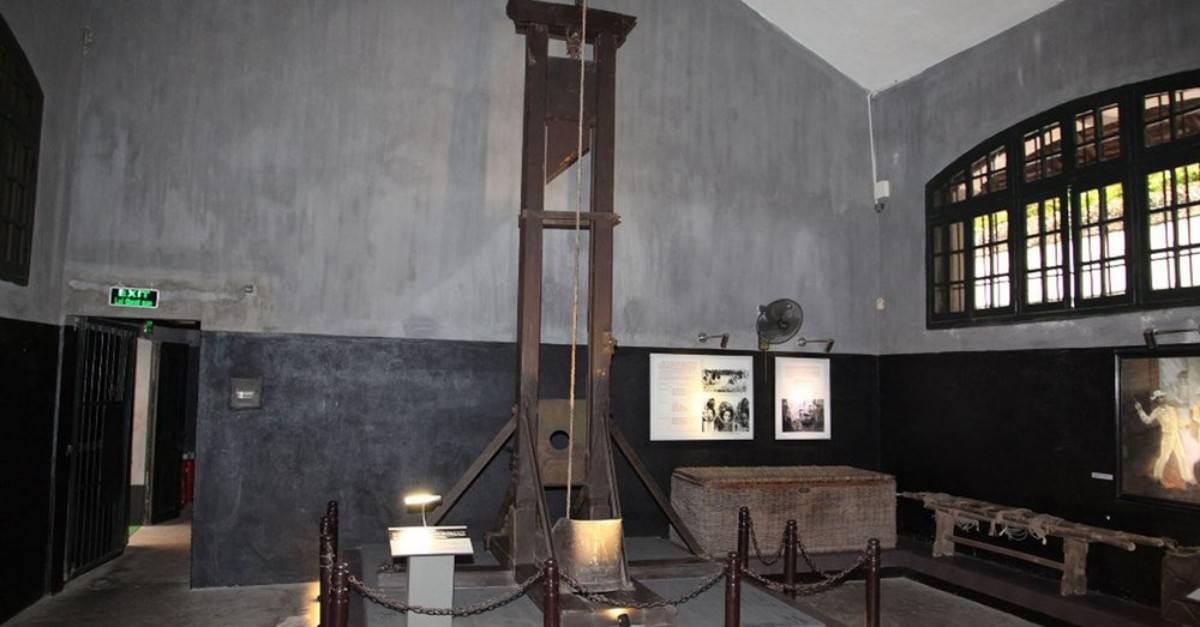
At the end of the row of colonial prisons stood the infamous French guillotine. The colonial authorities transported this special instrument of execution from prison to prison throughout North Vietnam. Standing right next to it, one could see the chilling efficiency of industrial methods applied to political repression in the 20th century.
.jpg)
The Love Tree
📌 Detailed information:
Locals and knowledgeable visitors often place flowers or incense at this rare symbol of hope, where prisoners once had contact with the outside world. Performing this ritual is a sign of profound respect for the lives lost.
In the central courtyard, a large banyan tree provided shade for the paving stones. The prisoners used its leaves and bark for medicinal purposes. They also used the tree's intricate root system as a secret meeting place to exchange messages and coordinate resistance activities under the watchful eyes of the guards.
%20(1).jpg)
Comparing Hoa Lo with other historical sites
To fully understand 20th-century Vietnamese history, you need to compare the political imprisonment at Hoa Lo Prison with the harsh realities of the fighting in the Cu Chi Tunnels and the vivid war documents at the War Remnants Museum.
Hoa Lo focuses heavily on the imprisonment in North Vietnam, the resistance of intellectuals, and the specific stories of captured pilots. It requires less physical endurance than outdoor locations. If your itinerary takes you to South Vietnam, comparing this experience to other historical sites in the South will provide important geographical context regarding the Indochina War and the Vietnam War.
| Standard | Hoa Lo Prison | War Remnants Museum | Cu Chi Tunnel |
|---|---|---|---|
| Location | Hanoi (Northern Vietnam) | Ho Chi Minh City (South) | Suburbs of Ho Chi Minh City (Southern Vietnam) |
| That is focus. | French colonies and prisoners of war | The American War (1965-1975) | Guerrilla tactics |
| Emotional intensity | A harsh sentence (solitary confinement) | Extremism (Image of Agent Orange exposure) | Moderate level (Physical claustrophobia) |
| Time required | 1.5 - 2 hours | 2-3 hours | Half-day trip |
(1).jpg)
---Related Articles---
- The complete guide to Vietnam visa on arrival
- Vietnam visa exemption: Latest rules, 5-year certificates, and entry conditions
- Vietnam visa extension and visa runs: Latest rules and DIY steps
- A complete guide to exploring Long Bien Bridge
- Vietnamese people: Origins, culture, and modern social etiquette







Comments