

What is the main attraction of Dương Lam village?
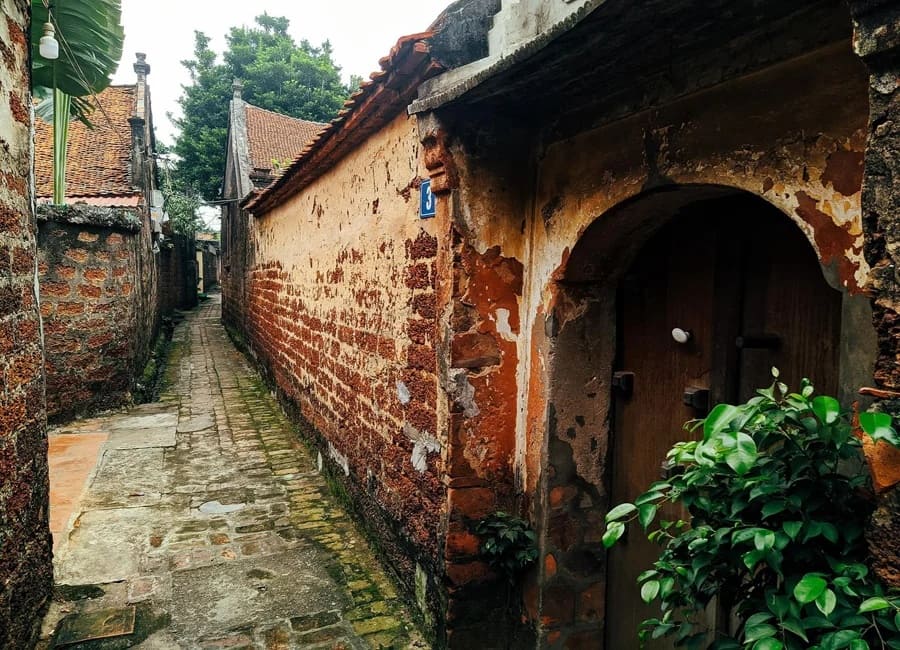
Dương Lam Ancient Village is renowned for its collection of over 900 well-preserved traditional Vietnamese houses, some 400 years old, built with laterite (Đá ong) and mud. The village layout follows an ancient fishbone structure. One central paved road branches out into numerous smaller, dead-end dirt alleys designed to confuse hostile invaders during the 17th century. These thick laterite walls physically absorb heat during the humid July summer and retain vital warmth throughout the January winter.
.jpg)
Key attractions anchor opposite ends of the settlement. Mia Pagoda (Chùa Mía) sits at the northern edge, boasting 287 distinct statues carved from jackfruit wood, bronze, and terracotta. The collection includes the highly venerated weeping Bodhisattva statue.
Moving toward the center, Mong Phu Communal House (Đình Mông Phụ) operates as a 17th-century architectural masterpiece. Built in 1684, this central structure features massive ironwood pillars resting on carved stone bases, operating as the spiritual anchor for the entire ward.
How do I get to Dương Lam Ancient Village?
Dương Lam Ancient Village is located approximately 50 kilometers west of Hanoi (Hà Nội). Drive time takes exactly 90 minutes via the Thang Long Boulevard when traveling outside the 8:00 AM rush hour, covering relatively flat highway terrain before turning onto provincial road 32. You can hire a private car through your hotel for roughly 1,000,000 VND ($39.37) for a half-day round trip, which provides direct point-to-point service without stopping.
Visitors can reach it economically by taking public transport, though it requires a transfer. Go to My Dinh Bus Station (Bến xe Mỹ Đình) and bypass the aggressive taxi drivers at the front entrance. Buy a ticket for public buses 70A, 71, or 77 directly from the counter for 20,000 VND ($0.79).
.jpg)
Ride this bus to the final stop at Son Tay town (Sơn Tây). Exit the vehicle and immediately hail a local motorbike taxi (xe ôm) for the final three kilometers. Negotiate the short ride to exactly 20,000 VND ($0.79) before you put on the plastic helmet.
Planning your self-guided day trip
- Leave central Hanoi by 7:30 AM to beat the heavy commuter traffic clogging the Thang Long Boulevard exit.
- Arrive at the Mong Phu village gate before 9:00 AM to secure a working rental bicycle before the large 50-person tour buses empty out.
- Walk immediately to the central communal house to photograph the uncrowded courtyard and examine the 300-year-old banyan tree.
- Cycle to Mia Pagoda exactly at 9:30 AM. The head caretaker locks the heavy wooden doors from 11:00 AM until 1:30 PM for lunch, and you cannot enter during this window.
- Order your lunch at a designated ancient house by 10:00 AM. Traditional slow-cooked pork requires hours of preparation, and unannounced walk-ins often receive cold leftovers.
- Pedal the 2.5 kilometers out to the remote temples of King Ngo Quyen and King Phung Hung at noon while the main alleys fill with other tourists.
- Return your bicycle at 2:00 PM and walk through the narrow residential dirt paths to observe farmers processing their afternoon harvest.
.jpg)
How much is the entrance fee for Duong Lam ancient village?
The current entrance fee for Duong Lam Ancient Village is 20,000 VND (approximately $0.79 USD) per person. Children under 1.2 meters tall enter the gates free of charge. Purchase your physical ticket directly at the small wooden booth stationed next to the lotus pond at the Mong Phu gate. Keep this paper stub in your pocket, as local guards conduct random ticket checks near the central square.
This fee goes to the local preservation fund, supporting community initiatives and the conservation of historical structures recognized by the Vietnamese Ministry of Culture, Sports and Tourism. Since the national government regulates structural changes, homeowners rely entirely on these collective tourist dollars to source historically accurate laterite bricks and clay tiles instead of using cheap, unauthorized concrete to patch their leaking roofs.
%20(1)(1).jpg)
What historical significance does Dương Lam Ancient Village hold?
Dương Lam is celebrated as Vietnam's first ancient village recognized as a national relic in 2006. Located in the fertile Red River Delta, it operates as a functioning agricultural ecosystem rather than a static museum. The community maintains manual farming practices that date back a millennium, utilizing the surrounding wetlands to cultivate wet rice, corn, and cassava for regional markets.
The settlement is famously known across the nation as the land of two kings, being the birthplace of national heroes Ngo Quyen (Ngô Quyền) and Phung Hung (Phùng Hưng). Ngo Quyen decisively defeated the massive Southern Han armada at the Bach Dang River in 938 AD by planting iron-tipped wooden stakes in the riverbed, ending 1,000 years of Chinese domination. Two centuries prior, Phung Hung led a massive and successful 8th-century rebellion against the Tang Dynasty. No other single village in Vietnam has produced two monarchs, prompting local historians to fiercely guard the original ancestral worship houses.
.jpg)
Exploring the ancient architecture
Laterite houses in Duong Lam are traditional Vietnamese dwellings constructed primarily from reddish laterite soil combined with mud or straw. Local builders dig this laterite out of the ground while it is soft and moist. After baking in the direct sun for several weeks, the rectangular blocks harden into a rock-like substance marked by deep porous holes.
These homes feature distinctive courtyards specifically designed for drying massive yields of harvested rice. You will see heavy wooden pillars supporting deep, sloping roofs covered in traditional clay tiles. The intricately carved details and high thresholds reflect design principles of the Later Le Dynasty, brilliantly showcased at Nguyen Thi Lan's ancient house. Homeowners built these raised wooden thresholds 15 centimeters high to stop wandering chickens from entering the formal living rooms.
(1).jpg)
📌 Insider note:
Skip the crowded main square and head straight to Mr. Hung's 400-year-old house. His courtyard contains dozens of authentic clay jars, making it the best location for laterite architecture photography. Afterward, walk two blocks north to Mr. The's 13-generation home. He charges 10,000 VND ($0.39) for green tea and will show you original family lineage documents dating back 300 years.
What traditional crafts or foods are unique to Dương Lam?
Dương Lam is famous for several traditional culinary products tied directly to its agricultural output. Local kitchens specialize in Che Lam (Chè Lam), a sticky rice cake made from roasted glutinous rice powder, crushed peanuts, fresh ginger, and molasses. You will also find Banh Te (Bánh Tẻ), a savory cake stuffed with minced pork and crunchy wood ear mushrooms, wrapped and steamed inside fresh banana leaves.
The village is also renowned for Tuong Duong Lam (Tương Đường Lâm), a fermented soybean paste often used in local braised fish dishes and boiled water spinach. Women produce this condiment by fermenting roasted soybeans and sticky rice in large ceramic clay jars. They leave these heavy unglazed pots directly out in the summer sun for up to three months to develop the signature sharp, salty flavor profile.
(1).jpg)
Where to eat and what to avoid
📌 Insider note:
Avoid the restaurants clustered immediately next to the Mong Phu Communal House, which serve dry, mass-produced meals to rushed tour groups. Instead, book lunch at Hai Loi’s house or Mrs. Ha Thi Dien’s house. For 150,000 VND ($5.91) per person, you receive slow-braised pork belly, fresh morning glory, and organic chicken raised directly behind their laterite walls.
Visual and logistical itinerary: navigating the village
Sample day itineraries and walking routes
- Start at the Mong Phu Gate at 8:30 AM, taking time to examine the 300-year-old banyan tree and the adjacent lotus pond before the crowds arrive.
- Walk straight down the main brick-paved artery to the Mong Phu Communal House, spending 20 minutes studying the carved wooden dragons on the roof beams.
- Navigate the narrow fishbone alleys north toward Giang Van Minh Worship House to view the artifacts of the 16th-century diplomat.
- Rent a bicycle for 50,000 VND ($1.97) from a local vendor and pedal the 2.5-kilometer scenic route past active rice paddies to the Ngo Quyen Temple.
- Stop at the Phung Hung Temple just 500 meters away, parking your bike outside the low laterite walls.
- Cycle back toward the village center and lock your bike at Mia Pagoda by 1:30 PM just as the caretaker unlocks the heavy doors.
%20(1).jpg)
Time and distance between key sites
| Site | Walking Time (from Gate) | Biking Time (from Gate) | Distance (from Gate) | Best time of day to visit |
|---|---|---|---|---|
| Mong Phu Gate | 0 mins | 0 mins | 0 km | 8:30 AM |
| Mia Pagoda | 15 mins | 5 mins | 1.2 km | 1:30 PM |
| Ngo Quyen Temple | 35 mins | 12 mins | 2.5 km | 11:00 AM |
| Chapel Giang Van Minh | 8 mins | 3 mins | 0.6 km | 10:00 AM |
Cultural etiquette and navigating staged authenticity
As daily tourism increases, Duong Lam struggles to balance its agricultural reality with foreign visitor expectations. Many prominent courtyards now feature strategically placed bamboo baskets and unblemished clay pots specifically positioned for photography tours. The vendors selling rice cakes at the central square deal with hundreds of foreigners daily, employing rehearsed sales tactics and expecting visitors to purchase multiple 20,000 VND ($0.79) boxes. You have to step off the primary paved pathways to see the working sections of the community.
Village life continues right behind the commercial drag. Walk down the narrow dirt alleys behind the communal house to find farmers threshing rice on blue plastic tarps. Mechanics repair rusted tractors next to laterite walls that look heavily weathered and unbothered by commercial preservation standards. Engaging with locals in these quiet residential zones yields highly practical interactions compared to the heavily rehearsed English routines at the front entrance.
.jpg)
Authenticity vs. tourism: what to expect
📌 Insider note:
Skip the heavily staged photo stops and seek out the hidden Gieng Sua (breastmilk well) near the Ban temple. According to local legend, the clear water here cured lactation issues for 19th-century mothers. Afterward, talk to the 78-year-old caretaker at Chapel Giang Van Minh. He has maintained the family shrine for 30 years and will explain the diplomat's tragic execution in China.
Cultural etiquette 101 and interacting with locals
- Wear long trousers or skirts that cover your knees when entering the sacred spaces of Mia Pagoda or the Ngo Quyen Temple.
- Ask explicitly for permission before crossing the threshold into any private residential courtyard by pointing to your camera and waiting for a nod.
- Say "Xin chào" (Sin chow) to the elderly residents sitting outside their homes to establish basic goodwill before taking out your phone.
- Buy a small 15,000 VND ($0.59) package of sesame candy if you plan to spend more than five minutes photographing a family's personal laterite walls.
- Remove your shoes entirely before stepping onto the elevated wooden sitting platforms inside the central communal house.
- Lower your voice when walking through the narrow residential alleys between 12:00 PM and 2:00 PM, as the entire farming community sleeps during this rest period.
(1).jpg)
Comparing cultural day trips from Hanoi
| Destination | Primary Focus | Main Attractions | Travel Time from Hanoi | Best for |
|---|---|---|---|---|
| Duong Lam Ancient Village | Historical architecture | Laterite houses, Mia Pagoda, Communal House | 90 minutes | Photography and rural history |
| Bat Trang Ceramic Village | Artisan crafts | Pottery market, ceramic workshops | 40 minutes | Hands-on workshops and shopping |
| Ninh Binh | Karst landscapes | Trang An boat tours, Mua Cave | 120 minutes | Nature and outdoor activities |
.jpg)
Frequently asked questions
Are credit cards accepted at shops and eateries in Duong Lam?
No, credit cards are entirely useless within the village limits. Every transaction requires cash, from the 20,000 VND ($0.79) entry ticket to the 150,000 VND ($5.91) home-cooked lunches. Bring smaller denominations like 10,000 and 20,000 VND bills, as elderly vendors selling peanut candy often lack change for large notes.
What are the operating hours for ancient houses open to visitors in Duong Lam?
The officially recognized ancient houses welcome visitors from 8:00 AM until 5:00 PM daily. However, homeowners strictly enforce an unwritten lunch break between 11:30 AM and 1:30 PM. If you knock during these two hours, you will find wooden doors shut while the residents eat and sleep inside.
Is it possible to rent bicycles within Duong Lam Ancient Village?
You can rent bicycles directly at the Mong Phu gate or at several cafes adjacent to the central communal house. Rentals cost a flat rate of 50,000 VND ($1.97) for the entire day. The bikes are basic, single-speed models with front baskets suited for the flat 2.5-kilometer ride.
Is Duong Lam Ancient Village easily accessible for visitors with limited mobility?
No. While the village itself is relatively flat, its ancient narrow alleys, uneven stone paths, and unpaved sections present challenges for individuals with limited mobility or wheelchair users. Many ancient houses also feature steps and raised thresholds that complicate access.
The courtyard entrances typically feature 15-centimeter high wooden barrier steps designed to keep wandering livestock out. Maneuvering a wheelchair inside the 400-year-old structures requires physical lifting by a companion, and the public bathroom facilities lack standard accessibility handrails or ramps.
What is it like to stay overnight in a homestay in Duong Lam?
Overnight stays offer complete silence after the tour buses depart at 4:00 PM. Accommodations like Duong Lam Homestay charge around 400,000 VND ($15.75) per night. Expect basic amenities including hard mattresses on wooden frames, shared bathroom facilities, and a rooster wake-up call promptly at 4:30 AM.
ảnh CTA TA








Comments