
When is the Mid-Autumn festival in Vietnam?
The Vietnam Mid-Autumn Festival (Tet Trung Thu) falls on the 15th day of the 8th lunar month, during the full moon. In 2026, the official date is September 25. Festivities and street decorations typically peak 2 to 5 days before the main event.
.jpg)
The exact Gregorian calendar date shifts annually, but it consistently lands between mid-September and early October. This timing aligns with the autumn equinox, historically marking the end of the summer rice harvest. You should anticipate regional weather variations during this window. Northern cities like Hanoi begin to cool down, whereas southern locations like Ho Chi Minh City experience frequent, short evening downpours.
Therefore, packing a compact umbrella and wearing quick-dry footwear is essential for street exploration. The official holiday is not a mandated day off for workers, meaning daily business operations continue normally. However, evening traffic drastically alters as neighborhoods prepare for twilight parades.
.jpg)
The pre-festival sweet spot
Arriving exactly on the full moon date guarantees maximum energy, but it also places you inside highly congested pedestrian zones. Shop owners are overwhelmed, and viewing the elaborate lantern displays requires shuffling through tightly packed crowds. Exploring these commercial districts earlier yields a much more comfortable experience.
📌 Expert Insight:
To experience the festive vibe without the crushing crowds, the best time to explore lantern streets is 2 to 5 days prior to the actual full moon. Rehearsals are active, but navigation is much easier.
During this lead-up period, local youth troupes actively practice their drum sequences and acrobatic routines in public parks. You can observe the fascinating supply chain of craftsmen delivering bamboo frames and cellophane bulk orders to retail storefronts. Furthermore, taking detailed photographs of the merchandise is significantly easier when you are not blocking a massive flow of foot traffic.
.jpg)
What is the legend behind Vietnam's Mid-Autumn festival?
The Vietnamese festival centers on the legend of Cuội, a man trapped on the moon with a mystical banyan tree. During the harvest reunion, children light star lanterns and parade through the alleys to guide Cuội's way back down to Earth.
According to local folklore, Cuội discovered a sacred tree with leaves that could revive the dead. After his wife accidentally watered the roots with impure water, the tree uprooted itself and began floating toward the sky. Cuội grasped the roots to anchor it but was pulled into the atmosphere.
.jpg)
Consequently, when you look at the full moon in Vietnam, locals claim you can see the dark silhouette of a man sitting beneath a large tree. The glowing lanterns carried by children serve as navigational beacons, inviting him back home for the autumn harvest. This story emphasizes themes of healing, nature, and community reliance.
Cultural nuances: Vietnam vs China Mid-Autumn
While both countries utilize the same lunar calendar, their festival priorities differ significantly. Chinese traditions focus heavily on romance, the legend of Chang'e, and formal family dinners. Conversely, Vietnam directs the holiday almost entirely toward the younger generation, making it the premier children's event of the year.
- Vietnam emphasizes a community-oriented 'children's festival' rather than just private family meals.
- The iconic presence of the Earth God (Ông Địa) mask playfully leading the lion dance processions.
.jpg)
Historically, agricultural parents spent the entire summer working exhaustively in the rice paddies. The autumn moon provided a necessary break to reconnect with their children, resulting in a toy-heavy, game-centric celebration. You will quickly notice the jovial Ông Địa character, recognized by his round belly and wide smile, playfully interacting with children and maintaining a lighthearted atmosphere.
What are the main traditions of Tet Trung Thu?
Main traditions include colorful lantern parades, rhythmic lion dances to ward off evil, wearing Ông Địa masks, and setting up outdoor altars. Families gather around these neighborhood displays to share dense mooncakes and drink hot tea late into the evening.
As sunset approaches, local ward committees barricade narrow alleys to block motorbikes. Children emerge carrying battery-operated or traditional candle-lit đèn ông sao (five-pointed star lanterns). The evening climaxes with the phá cỗ ceremony, where kids dismantle the intricate fruit and candy centerpieces arranged earlier in the day.
.jpg)
The lion dance prosperity ritual
The relentless striking of large drums and cymbals provides the auditory backdrop for the entire week. These instruments dictate the speed and intensity of the street performers. You will hear these percussive beats echoing through urban corridors from late afternoon until midnight.
- Lion dances (múa lân) are not just performances; they are rituals performed in front of local businesses to drive away bad luck and invite prosperity.
- Families set up outdoor altars to worship Thổ Công (God of Earth) with fruit and cakes.
Business owners frequently hang red envelopes containing cash (lì xì) from high balconies. The lion dancers must execute complicated human pyramids to reach the money. The higher the envelope hangs, the greater the skill required, and the more luck is bestowed upon the shop. If you stand near these storefronts, be prepared for performers to interact with you directly.
.jpg)
What foods are eaten during the festival?
Mooncakes are the central culinary staple during the Vietnamese Mid-Autumn Festival. Vietnam features two main types: Bánh Nướng (a golden baked crust) and Bánh Dẻo (a sticky, chewy white crust), filled with rich savory-sweet ingredients.
Weeks before the event, temporary corrugated metal stalls appear on major street corners. Brands like Kinh Do and local independent bakeries stack ornate boxes containing these dense treats. Traditional fillings combine varied ingredients such as lotus seed paste, mung bean, Chinese sausage, and dried candied fruits.
.jpg)
The salted egg yolk situated in the center of the cake represents the full moon. Beyond personal consumption, mooncakes serve as crucial social currency. Corporations purchase premium boxes to gift clients, while individuals buy them to show respect to elderly family members and teachers.
.jpg)
How to eat mooncakes like a local
📌 Expert Insight:
Traditional Vietnamese mooncake fillings are dense and much richer than Western cakes. They are best enjoyed in small, thin slices paired with hot green tea to balance the heaviness.
You should never attempt to eat an entire mooncake by yourself in one sitting. The extreme caloric density and intense sweetness will overwhelm your palate. Instead, utilize the small plastic knife provided inside the packaging to cut the pastry into eight wedges.
Pairing the cake with bitter beverages is mandatory. Traditional Vietnamese lotus tea (Trà Sen) or strong Thai Nguyen green tea cuts directly through the fat and sugar. This pairing cleanses your mouth between bites and enhances the complex flavors of the savory sausage and sweet lotus paste.
.jpg)
Where to celebrate Mid-Autumn festival in Vietnam?
Top spots include Hoi An's Ancient Town, Hanoi's Old Quarter, Ho Chi Minh City's Chợ Lớn, and Tuyen Quang. Your geographic location dictates the style of celebration, ranging from quiet riverside lantern floats to massive urban parades featuring illuminated structures.
Northern provinces typically lean heavily into historical roots and localized village activities. Southern districts incorporate louder, modern, and flashier elements. Choosing the correct destination requires aligning your travel preferences with the local festival intensity.
.jpg)
Comparing the top celebration hubs
If you prefer a high-energy street party, southern commercial centers deliver overwhelming sensory experiences. For a heritage-focused, slower evening, central coastal towns offer a more manageable pace.
| City | Vibe | Peak Celebration Days | Top Streets / Areas |
|---|---|---|---|
| Hanoi | Traditional, craft-focused | 2-3 nights | Hang Ma Street, Phung Hung Mural Street |
| Ho Chi Minh City | Urban, high-energy | 1-2 nights | Chợ Lớn (District 5), Luong Nhu Hoc |
| Hoi An | Heritage, atmospheric | 1 night | Ancient Town, Thu Bon Riverside |
| Tuyen Quang | Oversized, parade-heavy | 4 nights | City Center, Binh Thuan Square |
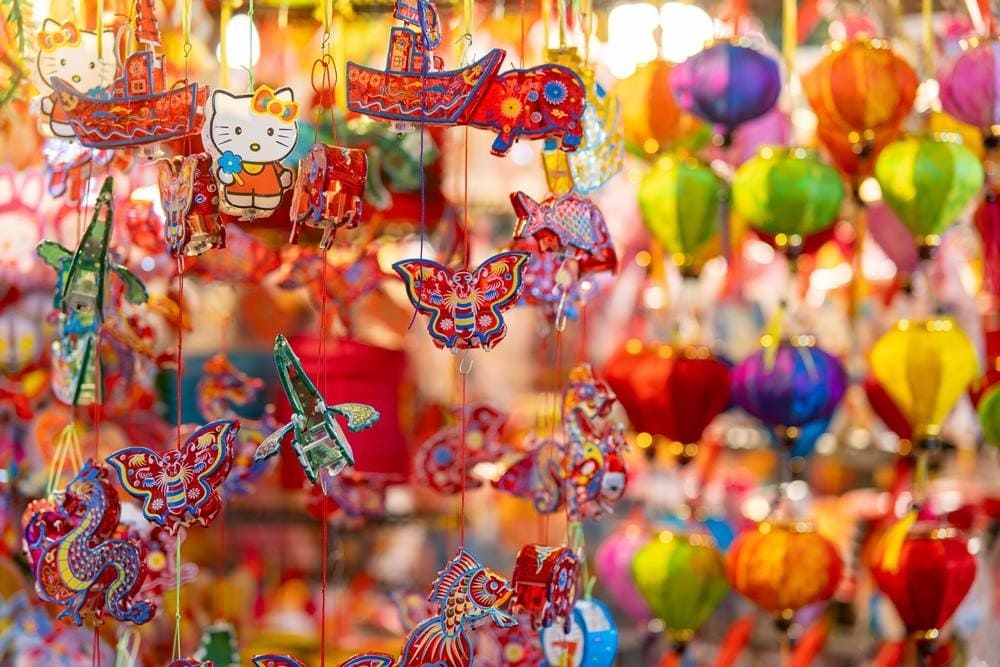
Tuyen Quang hosts the most visually striking Mid-Autumn event in the country, utilizing flatbed trucks to pull massive, brightly lit animal floats. If you want a localized spectacle far from standard tourist routes, this northern province requires booking accommodation months in advance. Meanwhile, Hanoi’s Hang Ma Street transforms into a tightly packed corridor of red and gold merchandise, ideal for observing the commercial scale of the holiday.
%20(1).jpg)
Photography etiquette and the lantern shop economy
Proper photography etiquette involves compensating store owners when using their storefronts as a backdrop. The lantern shop economy relies heavily on rapid sales during this short season, meaning obstructed entrances directly harm local vendors' daily income.
These retail spaces are incredibly narrow, often spanning only two meters wide. When multiple tourists stop to pose in front of the hanging displays, paying customers cannot browse. Consequently, vendor frustration is common in heavy tourist zones.
(1).jpg)
How to navigate photo hubs respectfully
📌 Expert Insight:
Many photogenic spots like Phung Hung Street (Hanoi) and Luong Nhu Hoc (HCMC) now charge a photography fee of 20,000-50,000 VND ($0.80-$2.00 USD) to take pictures at their stalls.
You should view this nominal fee as a temporary location rental. Vendors spend hours arranging delicate paper goods, and the sheer volume of visitors simply snapping photos without purchasing disrupts their livelihood. Paying the fee usually grants you a few minutes to pose with their props unbothered.
- Always ask for permission before snapping photos. A polite 'Chụp ảnh được không?' goes a long way.
- Seek out traditional star-shaped lanterns made of bamboo and red cellophane. Buy one ($1-$3 USD) to support local craft instead of just taking photos and leaving.
- Dress modestly if observing family altar ceremonies or taking photos near heritage houses and temples.
Additionally, using flash photography directly in the faces of lion dancers is dangerous. The performers execute complex jumps with highly restricted visibility inside the heavy costumes. Stand back, use a fast lens, and rely on the ambient street lighting to capture the action safely.
.jpg)
Festival night survival guide: Logistics and crowd safety
Standard municipal traffic rules dissolve during the peak evening hours. Sidewalks transform into overflow parking lots, forcing pedestrians into the active roadways. You must stay highly alert to your surroundings, especially regarding the slow-moving flow of mopeds navigating through the foot traffic.
Transport and perimeter drop-offs
Traffic management during the holiday is chaotic. Ride-hailing applications will display extended wait times and significant surge pricing. Attempting to drive a rental scooter into the core celebration zones will result in gridlock, eventually forcing you to push the bike manually.
- Do not rely on Grab or taxis taking you directly to the action. Road closures are common, and traffic slows to a crawl.
- Get dropped off at specific 'perimeter' landmarks (e.g., the edge of the Old Quarter or District 5 market gates) and walk the rest of the way.
Identify a clear meeting point with your group before entering the densest areas. Cell networks occasionally overload due to the high volume of users uploading videos simultaneously, causing temporary dead zones. Establishing a physical rally point prevents panic if someone gets separated.
(1).jpg)
Kid-specific advice and anti-scam tips
📌 Expert Insight:
Since it is a children's festival, foreign families should visit early. The ideal window is 5:00 PM to 6:30 PM before teenagers and dense motorbike traffic take over at 8:00 PM.
Arriving before sunset allows younger kids to actually see the lantern details and interact with street vendors. Once darkness falls, the environment shifts to a much louder, tighter adult crowd. Strollers become entirely useless against the crush of foot traffic on uneven, crowded pavements.
- Use anti-lost wristbands for young children as the 'Light Parades' become incredibly packed.
- Keep phones and valuables secured to prevent snatch-theft in slow-moving crowds.
- Be prepared to politely decline aggressive 'charity' lion dance troupes who may demand money after an unsolicited performance.
.jpg)
Legitimate lion dance troupes are hired in advance by specific businesses. Opportunistic groups may approach tourists on the sidewalk with a brief drum roll and an outstretched hat. A firm wave of the hand is sufficient to dismiss them without conflict. Always carry small denominations of Vietnamese Dong to pay for street food quickly without flashing large bills.
Accommodation and travel costs during harvest reunion
Travelers should anticipate higher hotel rates and book accommodations well in advance for the mid-autumn period. Prices fluctuate based on proximity to the main celebration zones, particularly in high-demand cities like Hoi An and Hanoi.
Securing a room directly overlooking the lantern streets provides a fantastic vantage point, but it comes with a premium price tag and high noise levels until midnight. If you value uninterrupted sleep, book a hotel in a neighboring district and commute to the festival perimeter.
Budgeting for your trip
Expect domestic travel networks to be operating near maximum capacity. Trains, such as the Reunification Express, sell out quickly as local workers return to their home provinces for family reunions. Securing tickets through platforms like Baolau or 12Go Asia at least one month prior is highly recommended.
| Accommodation Tier | Estimated Cost (USD per night) | Activity / Entry Fees |
|---|---|---|
| Standard (Guesthouses, 3-Star) | $43 - $45 | Street walking: Free, Lantern: $1-$3 |
| Mid-range (4-Star, Boutique) | $75 - $110 | Premium Mooncake Box: $15 - $30 |
| Luxury (5-Star, Resorts) | $122 - $463 | VinWonders Theme Parks: $19 - $58 |
.jpg)
Additional expenses during this period will mainly center around specialized food and seasonal souvenirs. Entry to major theme parks like VinWonders provides an alternative, structured way for families to celebrate the festival with organized shows and minimal street chaos. Regardless of your budget, careful planning ensures you navigate the Mid-Autumn holiday safely and efficiently.
CTA TA
Comments