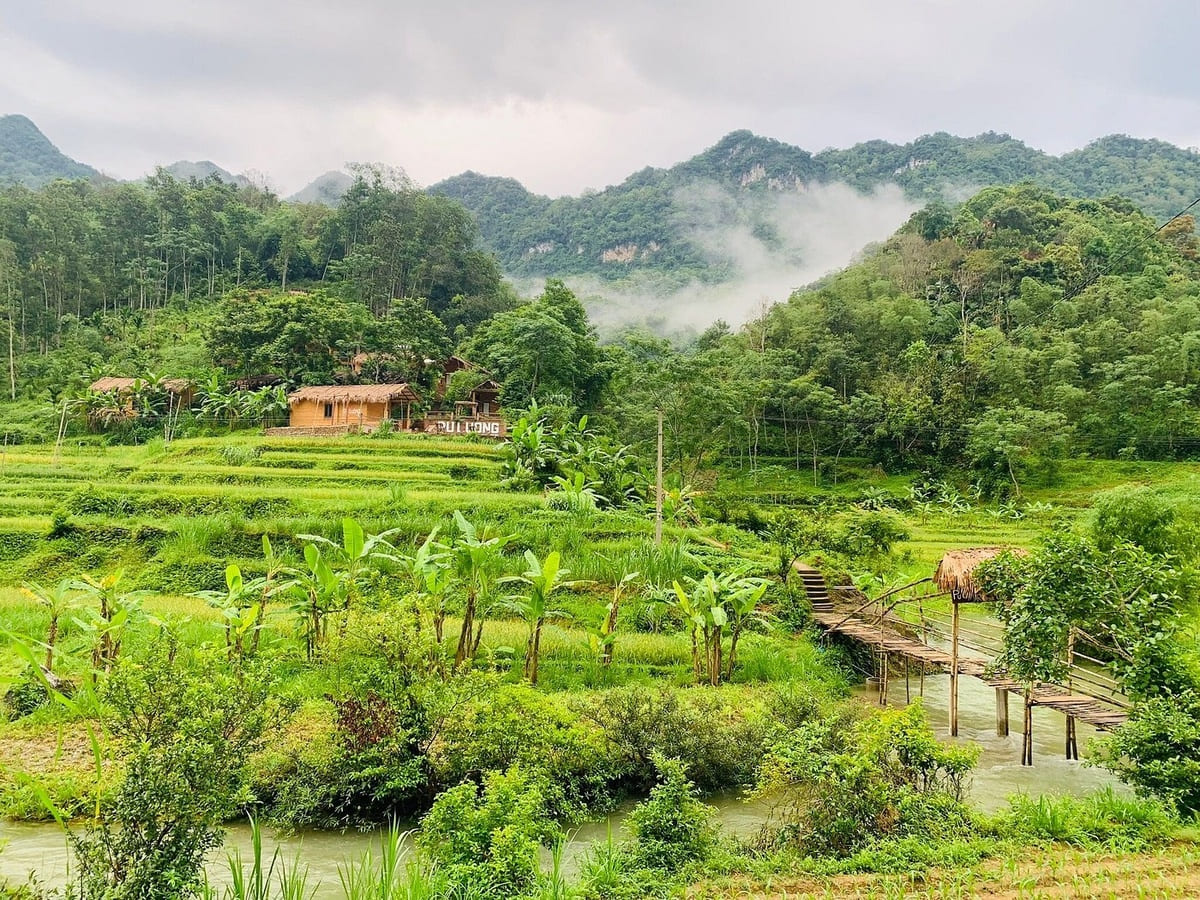

Nestled between jagged limestone mountains and verdant tropical rainforests, Pu Luong is the ultimate off-the-beaten-path escape. Whether you want to trek through emerald rice paddies, explore mysterious caves, or drift down a river on a traditional bamboo raft, this comprehensive guide breaks down the absolute best things to do in Pu Luong.
Pu Luong Nature Reserve encompasses 17,600 hectares of protected terrain in Thanh Hoa Province, defined by thick primary forests and steep limestone karsts. Traditional stilt house villages belonging to the Thai and Muong ethnic minorities border the terraced rice fields, providing a quiet alternative to heavily commercialized northern tourism hubs.
The reserve spans two main parallel mountain ridges framing a central valley network. Established in 1999 to protect local biodiversity, the zone connects with Cuc Phuong National Park to form a massive protected limestone corridor. You will not find large-scale hotels or paved highways cutting through the core area. Instead, narrow dirt tracks link small agricultural settlements where water buffalo still plow the fields.
Black Thai communities dominate the lower valleys, constructing their signature timber houses raised on thick wooden pillars. This architectural design protects residents from monsoon floods and wild animals while creating a shaded workspace beneath the living quarters. Muong villages occupy the higher elevations near Pu Bin, heavily relying on dry rice cultivation and foraging bamboo shoots from the surrounding old-growth forest.
.jpg)
You need at least two full days to trek through the central rice terraces, navigate Kho Muong Cave, and sleep in a traditional homestay. A three-day itinerary provides enough time to schedule bamboo rafting on the Cham River and swim at Hieu Waterfall without rushing your daily transit routes.
If you choose the two-day option, arrive early on the first morning. Spend your afternoon completing a 6-kilometer loop connecting Don Village with the lower Uoi and Lan hamlets. Use your second day for the strenuous hike down into the Kho Muong valley, visiting the bat cave before your afternoon departure back to Hanoi.
.jpg)
Adding a third day changes the entire pace of your trip. You gain the margin to drive 18 kilometers south to the Cham River. Here, local operators charge $8 per person for a one-hour float on traditional bamboo rafts, passing giant wooden waterwheels. The extra 24 hours also lets you tackle the steep 45-minute climb up the tiers of Hieu Waterfall for a midday swim.
The core attractions include the vast terraced rice fields surrounding Don Village, the 1,700-meter Pu Luong peak, and the deep caverns of Kho Muong Cave. Travelers also target Hieu Waterfall for swimming, the Cham River for bamboo rafting, and Pho Doan Market for Thursday and Sunday morning trading sessions.
.jpg)
Kho Muong Cave, known locally as Hang Doi or Bat Cave, requires descending a steep, slippery dirt path into an isolated depression. Inside, a 2.5-kilometer limestone chamber holds massive stalagmite formations and an underground river system. You must pay a $1 entry fee at the small wooden booth before entering the unlit cavern. Bring a strong headlamp, as natural light only penetrates the first 100 meters.
(1).jpg)
Pho Doan Market operates from 6 AM to 10 AM. Residents from remote highland outposts walk for hours to sell wild honey, live poultry, and hand-woven brocade fabrics. You can buy a fresh bamboo-tube rice snack for $0.50 while watching vendors negotiate prices for farming tools. Arrive before 7:30 AM to observe the heaviest trading volume before the crowds disperse back to their farms.
.jpg)
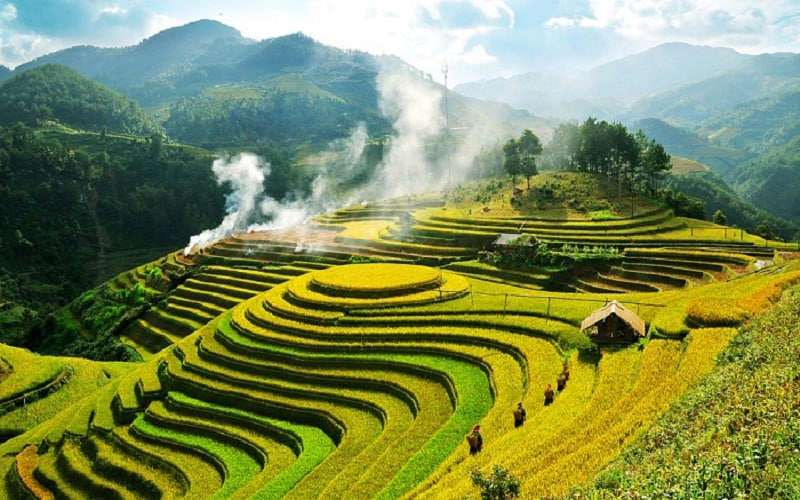
The optimal times for prime scenery are the golden rice harvest seasons running from late May to early June, and September to October. Alternatively, August brings mirror-like flooded terraces, while April and May draw thousands of white butterflies to the scenic dirt roads surrounding the remote Hieu Village.
Pu Luong operates on a dual-crop agricultural cycle, distinct from higher-altitude regions like Sapa which only manage one harvest per year. Farmers plant the first crop in February, turning the valleys bright green by April. By early June, the stalks turn yellow, signaling the first harvest window. The process repeats immediately, leading to the second golden season hitting its peak in mid-October.
.jpg)
Weather dictates trail conditions heavily. July and August bring heavy monsoon downpours that transform steep dirt paths into impassable clay slides. If you visit during these wet months, pack dry bags for your electronics and stick to the paved secondary roads connecting the main eco-lodges. Winter temperatures between December and February drop to 10°C, bringing thick fog that frequently obscures the valley views until midday.
Pu Luong is highly suitable for families seeking nature and outdoor activities, offering gentle valley walks and direct cultural interactions in traditional villages. While steep trails to the 1,700-meter peak challenge young kids, shorter walks to river waterwheels or relaxing by eco-lodge infinity pools provide highly accessible family-friendly entertainment.
Base your family in Don Village for the easiest logistics. Properties like Pu Luong Retreat and Pu Luong Eco Garden offer family suites, reliable electricity, and western food options for picky eaters. You can hire a local driver to bypass the steep hills, dropping you directly at the flat river valleys where toddlers can safely watch ducks and water buffalo.
.jpg)
Medical infrastructure remains highly limited. The nearest basic hospital sits in Ba Thuoc district, a 45-minute drive from the central reserve, while major emergencies require a four-hour transfer back to Hanoi. Pack a comprehensive first-aid kit containing antihistamines, motion sickness pills for the winding mountain roads, and pediatric paracetamol.
Choosing your base determines your daily transportation costs and trail access. The reserve spans a massive area, and transferring between valleys often requires a 40-minute drive on rough mountain passes. You must match your village choice with your physical fitness level and tolerance for rustic living conditions.
| Criteria | Atmosphere & Views | Accessibility | Proximity to key sights | Best for |
|---|---|---|---|---|
| Don Village | High-end eco-lodges, sweeping terrace views | Paved road access, easiest for cars | Close to main viewpoints, 0 Km dining | First-timers, families |
| Ban Hieu | Remote, dense jungle, sound of rushing water | Narrow dirt track, requires a 10-minute walk | Direct access to Hieu Waterfall | Adventurers, waterfall swimming |
| Kho Muong | Deep isolated valley, completely quiet | Very steep dirt descent, no cars | Direct access to Bat Cave | Budget trekkers, isolation |
| Pu Bin | High elevation, cool temperatures, pine forests | Winding mountain passes, far off main highway | Far from central terraces | Off-grid cultural immersion |
Sleeping in a Black Thai stilt house forces you to adapt to rural rhythms. The architecture features zero soundproofing. You will hear roosters at 4 AM, dogs barking across the valley, and the host family preparing breakfast in the ground-floor kitchen. Most standard homestays provide a thin mattress on a polished bamboo floor, separated from other guests by a simple fabric curtain.
.jpg)
📌 Insider note:
Ask to observe the host at Tai Dam Homestay in Don Village demonstrating her backstrap loom. She frequently weaves traditional Black Thai textiles in the shaded open space beneath her stilt house during her free time between 1 PM and 3 PM.
Bathrooms sit outside the main house. You must walk downstairs and cross a courtyard to use the toilets and showers. Hot water relies on solar heaters or small electric tanks, which frequently run out if you shower after sunset. Pack a headlamp for nighttime bathroom runs and a pair of slip-on sandals to navigate the muddy courtyards.
(1).jpg)
Do not rely on digital maps inside the reserve. Google Maps frequently routes drivers and hikers down abandoned logging tracks or paths that wash out during the rainy season. Cell service disappears entirely in the deep valleys like Kho Muong.
(1).jpg)
Guides save you from dead-end trails and aggressive farm dogs. They also translate conversations with farmers harvesting rice. Ask your guide to point out the specific bamboo species used for house construction versus the edible shoots harvested for dinner.
📌 Insider note:
Expect to pay typical price ranges of $25 to $40 per day per group for a local guide. This fee usually includes bottled water and a simple lunch. Always vet your guide through your homestay hosts rather than hiring solicitors off the street.
Minimize your luggage. You cannot roll a suitcase over gravel paths or up steep wooden stairs. Bring a 30-liter backpack for a two-day trip.
(1).jpg)
The 150-kilometer journey south from Hanoi requires navigating Highway 6 before transitioning to winding provincial roads. Traffic on the final 30 kilometers moves at a crawl due to wandering livestock and single-lane bridges.
(1).jpg)
Highland cuisine relies heavily on what residents can hunt, catch, or harvest within a five-mile radius. You will eat meals seasoned with mac khen, a wild pepper native to the northwestern forests that numbs the lips similarly to Sichuan peppercorns.
You must order Co Lung duck during your stay. Farmers raise these short-legged ducks directly in the fast-flowing streams, resulting in lean, highly flavorful meat. Kitchens typically roast the duck whole over charcoal, basting it with honey and local herbs. Pair this with com lam, sticky rice stuffed into hollow bamboo tubes and roasted over an open fire until the outer layer chars.
.jpg)
📌 Insider note:
Head to Pu Luong 0 Km in Don Village for traditional Co Lung duck, passion fruit chicken, or wood-fired pizza. Afterward, walk over to Na Co Nhan Oi cafe between 6 PM and 11 PM to catch sweeping sunset views over the central terraces.
Pu Luong functions as a working agricultural zone. Tourism supplements income, but farming dictates the daily schedule.
Observe the waterwheels operating along the Cham River. Farmers construct these massive bamboo circles by hand, using the river's current to turn the wheel. Small bamboo tubes attached to the rim scoop water from the river and dump it into overhead aqueducts, creating a zero-energy irrigation system for fields sitting above the water line.
.jpg)
Pu Luong receives significantly fewer visitors than neighboring Mai Chau, prioritizing small-scale eco-lodges over large commercial hotels. While Mai Chau features paved valley roads and extensive souvenir markets, Pu Luong retains dirt trails, fewer than 50 registered homestays, and relies heavily on agriculture for local income.
You can rent semi-automatic motorbikes from most homestays in Don Village for around $6 to $8 per day. Gas stations are scarce, so fill your tank in Pho Doan. Roads connecting the valleys feature 15-degree gradients, blind corners, and frequent loose gravel patches that challenge inexperienced riders.
Traditional stilt house dormitories cost between $8 and $12 per night, including a basic mattress, mosquito net, and shared bathroom facilities. Private bungalows at mid-range eco-lodges range from $45 to $70, while premium properties featuring infinity pools charge upwards of $120 during the peak October harvest season.
Sudden monsoon rains between July and August turn the clay trails leading to Kho Muong Cave into severe slip hazards. Unmarked paths connecting remote settlements like Pu Bin frequently confuse solo hikers. Venomous green pit vipers inhabit the dense jungle, making sturdy boots and local guides essential.
CTA
Best visited during dry season (November to April) for ideal weather.
Book accommodations in advance during peak travel season.
Carry local currency (Vietnamese Dong) for markets and small vendors.
Respect local customs and dress modestly when visiting temples.